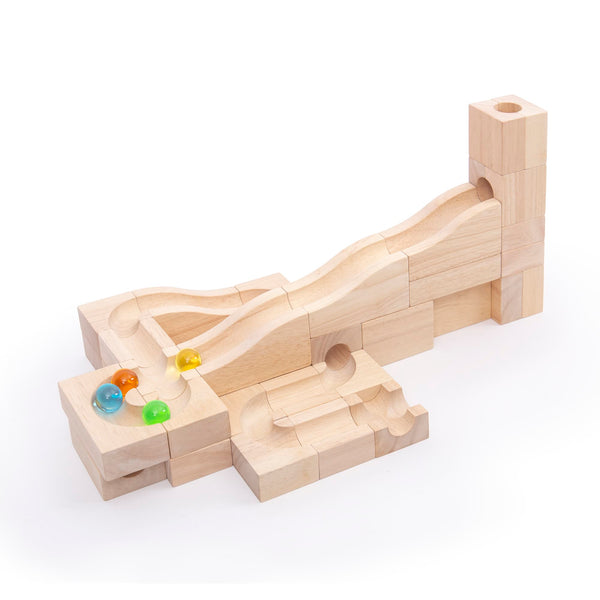
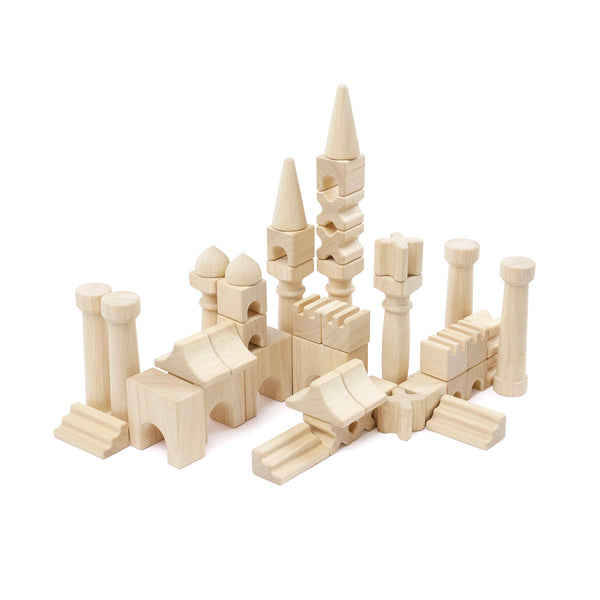
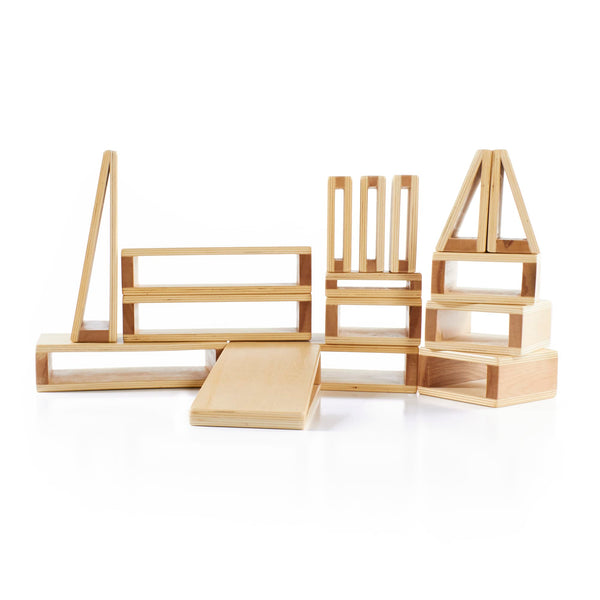
Wooden blocks with colorful gem-like inserts are arranged on a mirror atop a light wooden surface.

Unit Block System

Unit blocks are the ultimate open-ended toy for play based learning. Rooted in the understanding that children build knowledge through hands-on experience, block play lays the foundation for learning through play. Originally developed over 100 years ago, Guidecraft has innovated on the unit block system to facilitate exploration in light, color, and design. Every satisfying, mathematically-aligned piece seamlessly coordinates, providing opportunities for large-scale builds, STEM problem-solving, child-directed storytelling and more.

FAQs

Unit blocks are mathematically-designed building block system built around a standard unit (5.5" x 2.25" x 1.375"). Every shape in the set is a precise fraction or multiple of that base unit, which means STEM concepts are embedded in the play itself. First developed in 1914 by Caroline Pratt, unit blocks were designed to support open-ended, child-directed learning. Guidecraft offers them in traditional hardwood and acrylic.

Guidecraft unit blocks stand apart because:

  • They are available in both traditional hardwood and acrylic options, including the world's first acrylic unit blocks. 
  • Every piece follows the same standardized sizing system, where each block is a precise multiple or fraction of the base unit. 
  • All sets are fully compatible, creating stronger builds and allowing collections to grow seamlessly over time. 
  • Acrylic blocks introduce a new dimension of play, encouraging exploration of light, color, shadows, and physics concepts. 

Yes. Every set in the Guidecraft Unit Block System shares the same sizing standard, so any combination of sets will fit and build together seamlessly. Collections can grow over time without compatibility concerns.

Yes. Depending on the set, children can build with: 

  • Unit blocks 
  • Half units 
  • Double units 
  • Arches 
  • Columns 
  • Curves 
  • Roof boards 

Because every shape follows the same mathematical system, children naturally discover concepts like equivalency, proportion, and symmetry while building. 

Families choose Guidecraft for our quality materials, intentional design, and educational value. The play experiences unit blocks offer grows naturally with children. At Guidecraft, we make it easy for families to build a strong collection, with every product in our extensive unit block system designed to work together.

Guidecraft's acrylic blocks are the first of their kind and bring an entirely new dimension to unit block play. Their transparency and color allow children to investigate light refraction, shadow and color mixing. They follow the same sizing system as wooden unit blocks and easily integrate into any existing collection.

Hardwood unit blocks are durable, satisfyingly weighted and naturally grippy when uncoated, which helps structures hold together during building. Their neutral, unpainted appearance makes them a versatile tool for all kinds of creative play.

Block building is hands-on scientific thinking. Children constantly test ideas: Will this balance? What happens if I change the structure? 

They observe cause and effect, work with gravity and force, explore balance and stability, and develop engineering and design thinking skills as they build, test, and adjust their structures. 

Guidecraft's acrylic blocks add another layer, giving children the opportunity to explore light, color mixing, and basic physics concepts through open-ended play. 

Because every block is a fraction or multiple of the base unit, children encounter math organically. Reaching for two half-units when they run out of full units is an introduction to fractions. Noticing that a double unit spans two single units is an introduction to multiplication. Concepts like geometry, sequencing, and equivalency emerge the same way, through exploration rather than instruction.

Yes. The physical demands of block play, including carrying, lifting, stacking and arranging, support the development of gross motor skills, coordination and body awareness.

Block structures naturally become settings for stories and dramatic play. A simple arrangement of blocks can become a house, a bridge, a habitat, or an entire small world. Children often use block play to revisit and make sense of real experiences taking place in their lives.

Because there are no instructions or fixed outcomes, children can approach unit blocks entirely on their own terms. This freedom builds confidence and self-direction. Children also tend to talk through their builds, narrating what they're making and how it works, which supports vocabulary and communication skills alongside the independent play itself.

Unit blocks support a wide range of play types:

  • Construction play
  • Storytelling
  • Dramatic play
  • Sensory exploration
  • Collaborative building
  • Scientific experimentation
  • Small-world play

Their open-ended, neutral design means children can use them to explore nearly anything, including recreating places they've been or working through experiences that feel big or meaningful.

Yes. Acrylic block sets pair beautifully with light tables and natural light, encouraging the exploration of shadows, transparency, color mixing and visual patterns.

Yes. Research on block play shows that children move through a sequence of increasingly complex building stages, from simple stacking all the way to building detailed representations of real places and structures. A foundational set is a great starting point, and compatible sets and accessories can be added over time as interests and abilities develop.

Guidecraft unit blocks can be paired with compatible accessories, acrylic pieces and accessible shelving to create organized, inviting block play areas that encourage independent exploration. Any product in the unit block collection will align flawlessly with other unit block products - this makes it easy to build your collection within the mathematical system. 

load more

Build Bigger Ideas with the Unit Block System

Open-ended block play gives children the freedom to think creatively, solve problems, and build confidence through hands-on exploration. Guidecraft’s Unit Blocks collection is designed to support meaningful learning experiences for homes, preschools, and educational institutions. With carefully crafted pieces and expandable systems, children have the materials they need to create large structures, imaginative worlds, and collaborative builds that grow more advanced over time.

From simple stacking to complex architectural creations, these learning blocks encourage kids to experiment, plan, and discover through play.

Why Unit Blocks Matter for Early Learning

Unit Block play is one of the most valuable tools in early childhood education. High-quality unit blocks for kids help preschoolers develop spatial reasoning, problem-solving skills, balance, coordination, and creativity while supporting both independent and collaborative play.

Guidecraft’s block systems are inspired by Montessori methodology and classroom learning principles, making them ideal for preschool classrooms, homeschool spaces, and educational environments. Children naturally explore STEM concepts like measurement, symmetry, engineering, and cause-and-effect while building with building blocks for learning.

These systems pair naturally with educational toys for kids, building toys, and wooden toys, helping educators and families create complete learning environments.

Designed for Real Classroom and Preschool Play

A successful building play experience depends on having enough materials for children to build freely and think big. That is why Guidecraft’s Unit Block System is designed to expand over time with a variety of shapes, accessories, and sensory elements.

Our collection includes traditional wooden blocks alongside translucent and transparent acrylic pieces that support sensory learning and light exploration. These sensory blocks work beautifully with light tables, allowing children to experiment with color, reflection, light, and shadow.

Children can also combine light table manipulatives, light table toys, and translucent acrylic blocks to create engaging STEM-based activities that encourage observation and experimentation.

Educational Benefits of Unit Block Play

Block systems support multiple areas of development at once.

  • STEM learning through balance, engineering, and problem-solving
  • Gross motor development through lifting, stacking, and large-scale building
  • Fine motor skills through sorting and precise placement
  • Sensory learning through texture, transparency, light, and color exploration
  • Social development through collaborative building and pretend play

These experiences pair naturally with sensory toys, science toys, and pretend play toys, creating richer learning opportunities for preschoolers and young learners.

For Different Ages and Learning Stages

Children use blocks differently as they grow.

  • Toddlers explore stacking and simple cause-and-effect with learning blocks
  • Preschoolers build roads, towers, and imaginative structures
  • Older children design more advanced creations and STEM-based builds
  • Classrooms use collaborative block play to encourage teamwork and communication

Families and educational institutions can expand play experiences further with best magnetic blocks, STEM toys, nature toys, toddler toys, and outdoor toys for kids.

Built for Long-Term Learning

Guidecraft Unit Blocks are crafted from durable materials designed to withstand years of classroom and home use. Smooth wooden finishes, consistent sizing, and thoughtfully designed accessories ensure reliable building experiences every day.

Create a Learning Environment That Grows with Children

The Unit Block System gives children the freedom to imagine, experiment, and build without limits. Whether used in a preschool classroom, educational institution, or home playroom, these Montessori blocks and sensory learning materials help children develop creativity, confidence, and essential early learning skills through hands-on discovery.

Explore the full collection and create a block play environment where children can build, learn, and grow together.